

- Pull latest or historical metrics
- Build dashboards and models
- Compare assets, networks, exchanges, and sectors
Installation
You can find the add-on in the Google Workspace Marketplace: https://workspace.google.com/marketplace/app/messari/393080319856?flow_type=2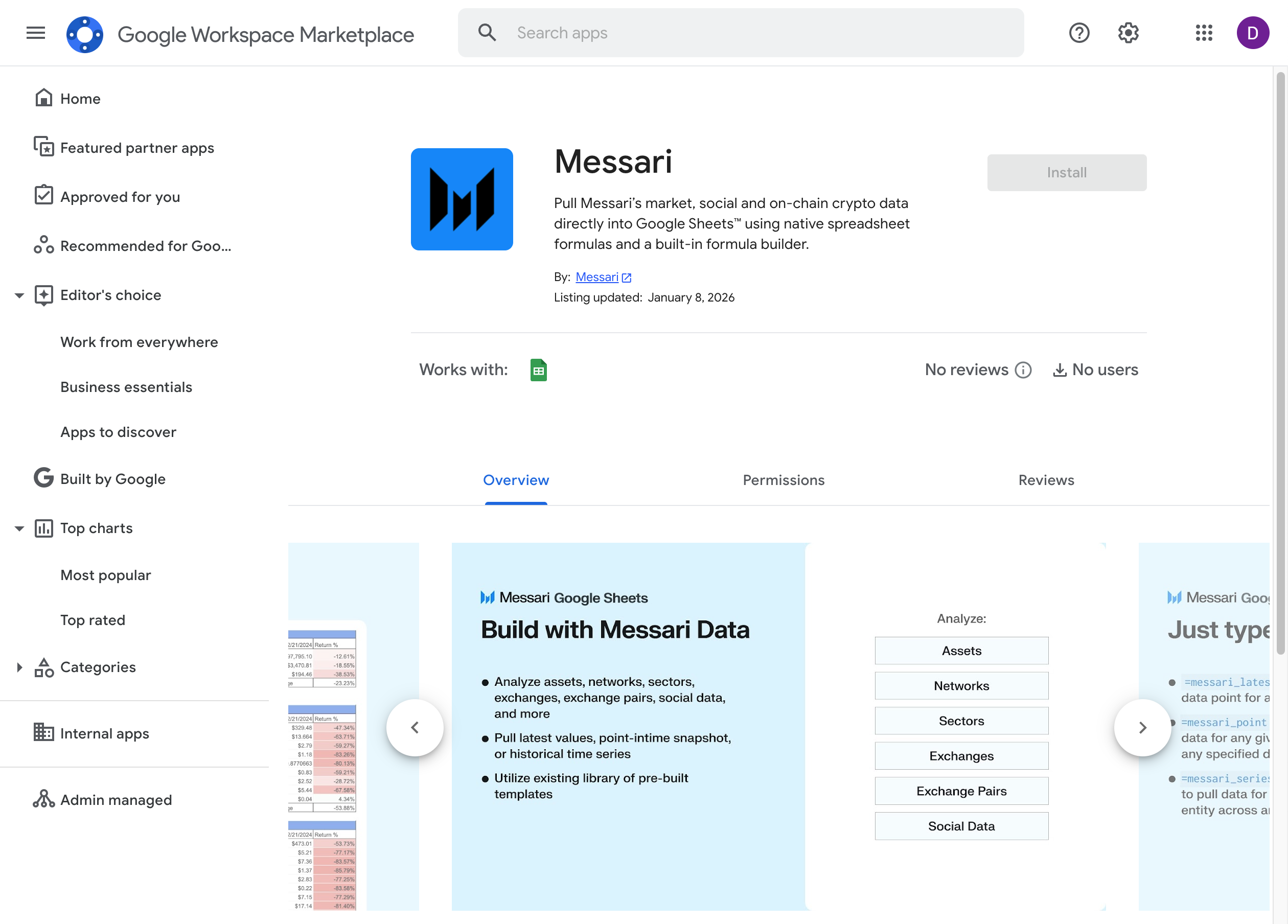
Launch Add-On
Go to the toolbar under “Extension” > Select “Messari” > “Open Sidebar”-4.png?fit=max&auto=format&n=cYz0DQw42UtT6GRA&q=85&s=7b8990d7d0bb33f030aaedbc7afcd160)
Authentication
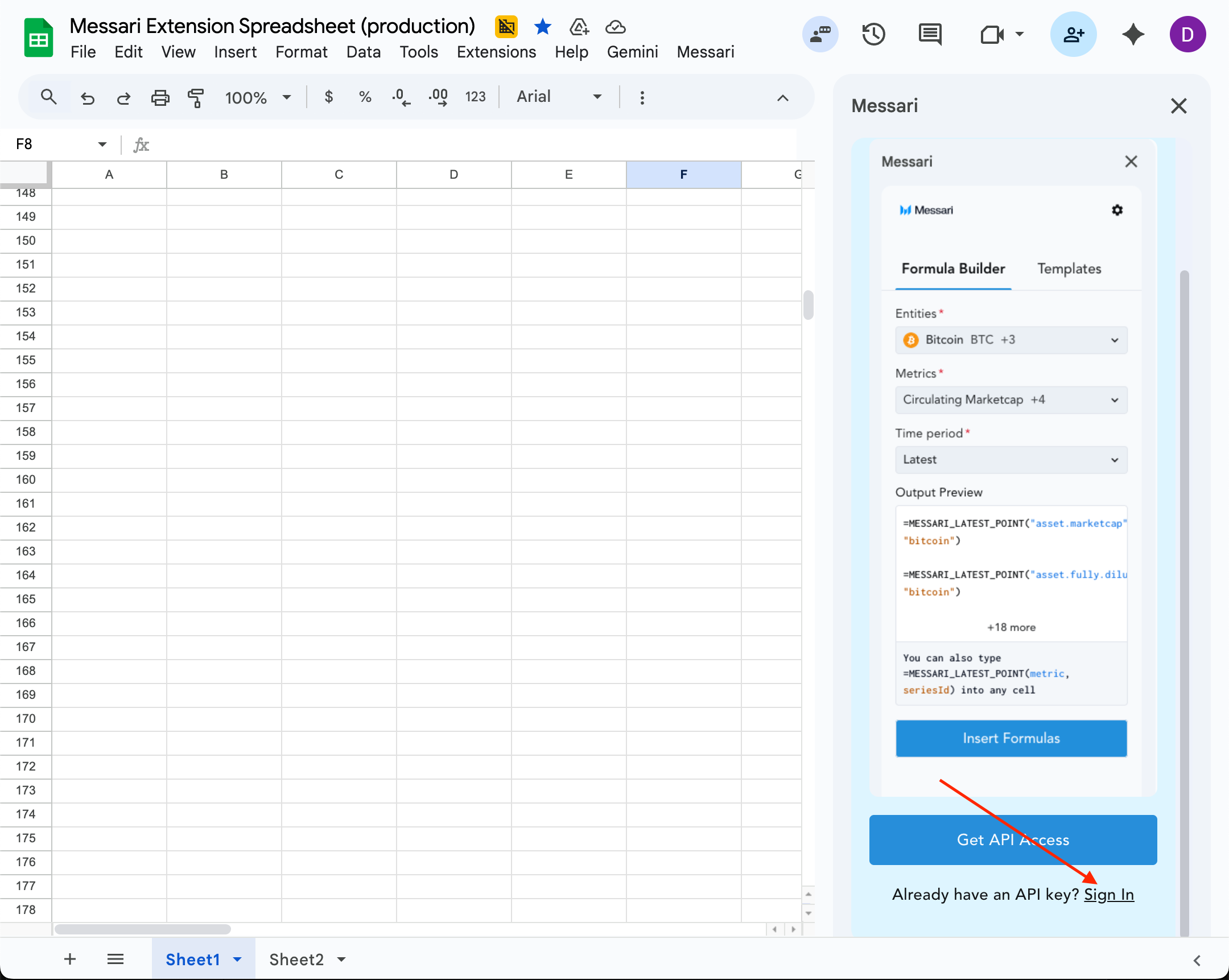
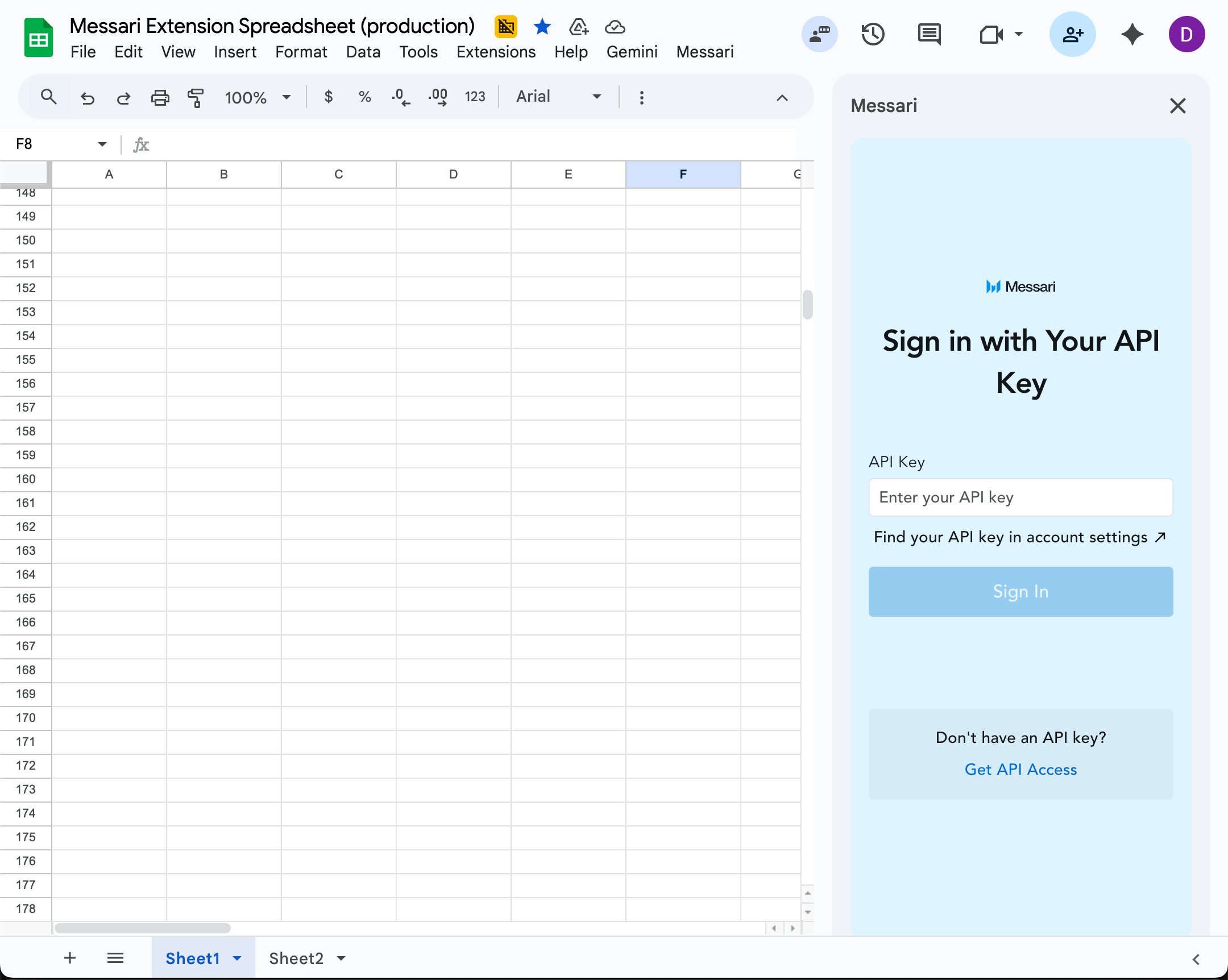
After selecting “Get Started”, you’ll be prompted to authenticate with your Messari API key.- If you are an existing Messari user, you can view / generate your API key under account settings: https://messari.io/account/api
- If you are not a Messari user, you can sign up for an enterprise account here: https://messari.io/enterprise/signup
Using the Formula Builder
The Formula Builder is the easiest way to get started and discover available data.Step 1: Select an entity
Choose what you want to analyze:- Assets
- Assets on a specific network
- Projects
- Projects on a specific network
- Networks
- Exchanges
- Exchanges on Networks
- Sectors
- Sub-Sectors
- Markets
Step 2: Select a metric
After selecting an entity, choose a metric such as:- Market cap
- Volume
- Price
- TVL
- Revenue
- Mindshare
Note: If you don’t see any metrics after selecting an entity, Messari may not currently have data coverage for that entity and metric combination, or the metric may not be included in your current API access.
Step 3: Select a time period
Choose how you want the data returned:- Latest
- Specific date
- Last 7 / 14 / 30 days
- Custom date range
Step 4: Insert or copy the formula
Click Insert Formula to insert the formula directly into the selected cell. You can also copy the formula and paste it into any cell manually.Formula Syntax
You can always write formulas directly without using the builder.=messari_point
Returns the value for a specific date.
Syntax
=messari_latest_point
Returns the most recent daily value.
Syntax
=messari_series
Returns a time series over a date range.
Syntax
Access to Metrics
Access to specific metrics in the Messari spreadsheet plugin is determined by your organization’s API permissions. By default, enterprise organizations have access to market, exchange, and asset metrics. Access to additional datasets such as on-chain metrics, mindshare, and sentiment requires the corresponding API permissions. You can view your available APIs and permissions in your account settings:https://messari.io/account/api . If a metric does not appear in the Formula Builder, it may not be included in your current API access.